
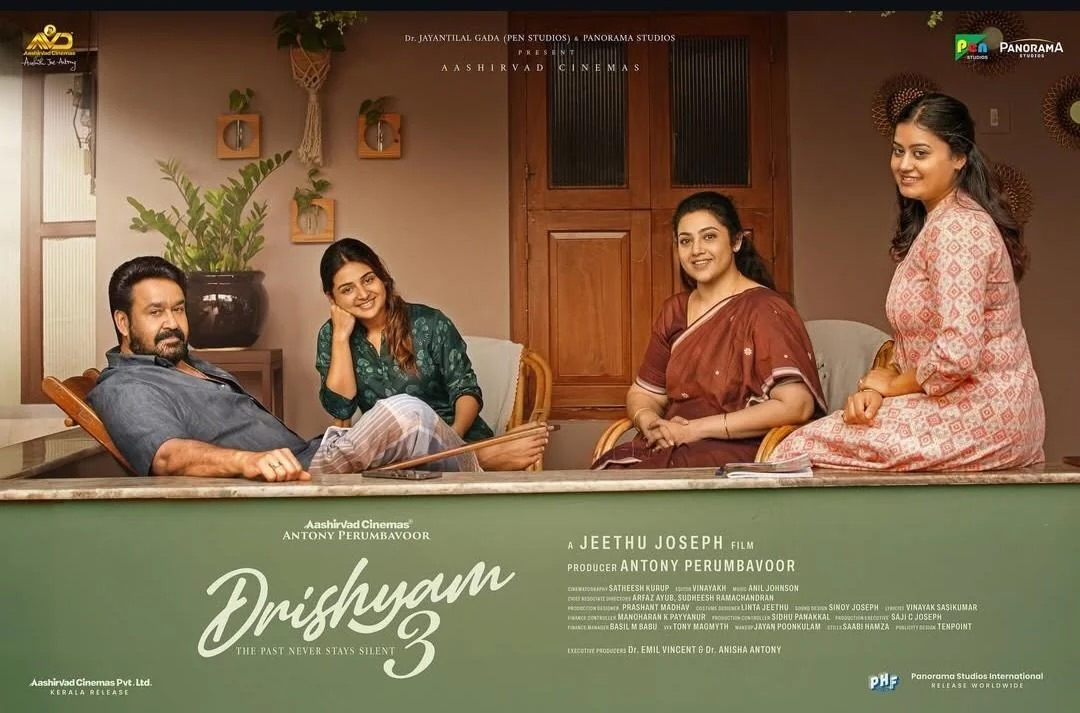
Drishyam 3 is beautifully conceived and is without a doubt a fantastic update to the franchise in terms of the story progression. It preserves the wonderful chaotic duel between unfolding of oftentimes pre-planned sequences of events and the protagonist’s ability to respond, stretching it further by pitting him against a massive two-year old scheme.
However, I found the execution of the narrative in the second half somewhat jarring and, at times, lacking in coherence. I do think that this is somewhat intentional, as the makers are also under pressure to keep the hero present in almost every frame and that he bears witness to the shocked faces of both his allies and adversaries.
In this article, I will outline a reimagining of the second half of the movie along with an alternative ending which I think fits the trajectory of Drishyam better - at least for some viewers like me. Obviously, this will contain spoilers, so, if you have not seen the movie, please avoid reading any further.
Segment 1 🔗
The first segment of the plot’s unravelling shows Prabhakar revealing his masterful two-year plan to the IG. This segment is mostly retained as is, with some added clarity. This segment is split into two clear parts. The first part is what has already happened. The second part is what is supposed to happen.
An example: the events at the resort happen as depicted in the movie but ending with the cops actually entering the house and arresting George and his daughter, clearly demarcating it as a “supposed to happen” segment.
Perspective: The Plan: What’s supposed to happen
Narrator: Prabhakar
Audience: IG Thomas
Segment 2 🔗
Here we take a clean break from the movie’s script. Once Prabhakar reveals what is supposed to happen, we cut to the hospital. The attending doctor lists the injuries the daughter has suffered as the cops begin their inquiry. The daughter narrates the happenings so (which is played out):
I suddenly woke up and saw blood all over me. At a distance, Sahadevan and my husband were also pouring more blood and making marks on the wall. I screamed “What’s happening, why is he here, why is there blood all over me?”. When he heard me wake up, Sahadevan got furious. He yelled, “Didn’t you give her the right dose?” and they started fighting. Sahadevan hit my husband. It was so hard that he fell on the floor and must have broken his neck. He looked unquestionably dead. Sahadevan screamed “See what you did” and started hitting me. Fortunately my father’s car was loud as it was racing close. Hearing this, Sahadevan picked up my husband’s body and went through the back door. My father came in and immediately called the hospital. You know the rest as you arrived soon after.
After recording her testimony, the cops call the IG to summarize their findings. And we merge back into the script. IG yelling at Prabhakar on how Sahadevan is unreliable and they dash out.
Here we make two significant departures. First, on how the deflection gets revealed. It gets revealed by the source of the assault: the daughter. This adds more coherence, meat for the actual victim here, the daughter, and a lot of emotional grounding. Second, on the content of the revelation. The daughter clearly hints at the conspiracy. This ensures that any attempt at rebuttal by presenting the “clearly not dead” husband will have to contend with the evidence of conspiracy.
Additionally, it adds deceptive confirmation. The audience is now convinced how the daughter is in the hospital and how she sustained the injury. This makes the final reveal even more impactful. The plot divergence mechanic is also in play as the resort scene ends with the ambulance carrying the daughter and George and the cops following them.
Perspective: The Deflection: What happened according to the daughter
Narrator: Daughter
Audience: Cops
Segment 3 🔗
George’s wife, younger daughter and the advocate arrive at the hospital. At this point, the final revelation is made on the actual sequence of events. George narrates what he did and why did it as everyone looks in awe, as the narration is played out we end with the same scene (ambulance) as the deflection segment showing the convergence.
Then we cut to Prabhakar and IG Thomas. Prabhakar receives a call from the supposed to be dead husband, leaving them stunned. After we linger a few seconds on their absolute disbelief, IG Thomas receives a call from his officers that they have located and arrested Sahadevan. The IG instructs that no one should take his statement until he gets a chance to talk to him.
Here we make a departure by changing when and how the final revelation happens. I believe this adds a lot of coherence. Additionally, this also removes the scene where George confronts Sahadevan and records his confession, a sequence that is chronologically difficult to explain.
The need for the confession is alleviated by the daughter’s testimony about conspiratorial intent and the alternative ending which will follow.
Perspective: The Reality: What actually happened
Narrator: George (Indirectly, the not dead husband)
Audience: Mother, Other Daughter, Advocate (Indirectly, IG/Prabhakar)
Bonus: Alternate Ending 🔗
IG / Prabhakar convince Sahadevan to plead guilty assuring that they will find a way to get him out. Geetha gets down from the plane. Sahadevan’s daughter is waiting to receive her. George’s daughter marries the director of his film and the family moves to a new home. She gets a teary send off with George repenting profusely and wishing her all happiness to account for all the pain she has endured.
This keeps the plot and George’s arc in full play for a potential Drishyam 4. With this ending, we do away with George taking the burden of the murder, which is not enough anyway as their intent to harm the daughter has been demonstrated already.
His absence also means his daughter and his family are unprotected. With the amount of detractors he has accumulated, they become sitting ducks without his intuitive and strategic mind. We also bring back Sahadevan’s daughter as key player for the next round.
Emotionally, it compensates the daughter. Allows George’s response. It doesn’t allow George to balance anything as it is hard for humans (mere catalysts as a character says) to know what constitutes a fine balance.
Summary 🔗
- The narrative impossibility of George’s omnipresence is eliminated
- The ever-so calculating George would not miscalculate the implications of him being in prison and Geetha with nothing to lose. He wouldn’t put all this effort to protect his family at the mercy of chance.
- The marriage adds an ally and protects his daughter.
- The daughter who has endured so much gets emotional impact and agency.
- The “deceptive confirmation” enhances the impact of the final revelation making it more potent.
- Drishyam 4’s possibility remains intriguingly open with all characters in play.
While I believe that this reduces quite a few frames for the hero, it compensates by clarifying the narration, adding emotional presence for the daughter, making it more coherent and keeping the plot alive. Hope this gets made in some alternate timeline and I somehow get to know how this movie fares :)